Acquisition number: 1970.05
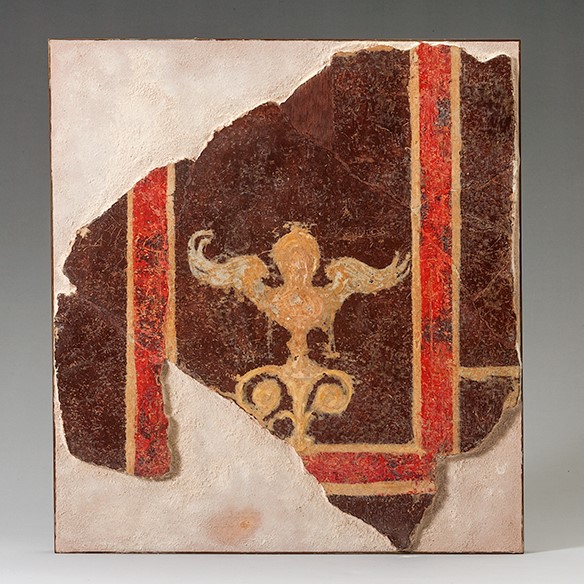
The fragment has a siren on a double volute within a frame. The background is brown, the frame red; both have a smooth polished surface. The outline of the frame, the volute and much of the siren are yellow; this paint has a rougher, less even surface. The face and breast of the siren were a flesh colour with brown details, now much worn. There are traces of other motifs in yellow in the panels to left and right.
The fragment is well preserved. There is some slight repainting along the joins and a triangular area is restored at the top, above the siren’s head.
Title: Fragment of Roman Wall-Painting - 1970.05
Acquisition number: 1970.05
Culture or period: Roman Imperial
Date: Mid 1st century AD.
Material: Plaster
Object type: Wall-painting
Dimensions: 265mm (w) × 290mm (h)
Origin region or location: Italy
Display case or on loan: 12
Keywords: Roman, Imperial, Fragment, wall painting
Three Thousand Years of Classical Art (Exhibition Cat., Sydney 1970) no. 117; J.R. Green with B. Rawson, Catalogue of Antiquities in the Australian National University, A.N.U. (Canberra, 1981) 108.
1970.05
Fragment of Roman Wall-Painting
Purchased. Max. ht 29cm; max. width 26.5cm.
The fragment has a siren on a double volute within a frame. The background is brown, the frame red; both have a smooth polished surface. The outline of the frame, the volute and much of the siren are yellow; this paint has a rougher, less even surface. The face and breast of the siren were a flesh colour with brown details, now much worn. There are traces of other motifs in yellow in the panels to left and right.
The fragment is well preserved. There is some slight repainting along the joins and a triangular area is restored at the top, above the siren’s head.
Mid-first century AD; late Third or early Fourth Style.
Three Thousand Years of Classical Art (Exhibition Cat., Sydney 1970) no. 117; J.R. Green with B. Rawson, Catalogue of Antiquities in the Australian National University, A.N.U. (Canberra, 1981) 108.