Acquisition number: 2013.03
Other images


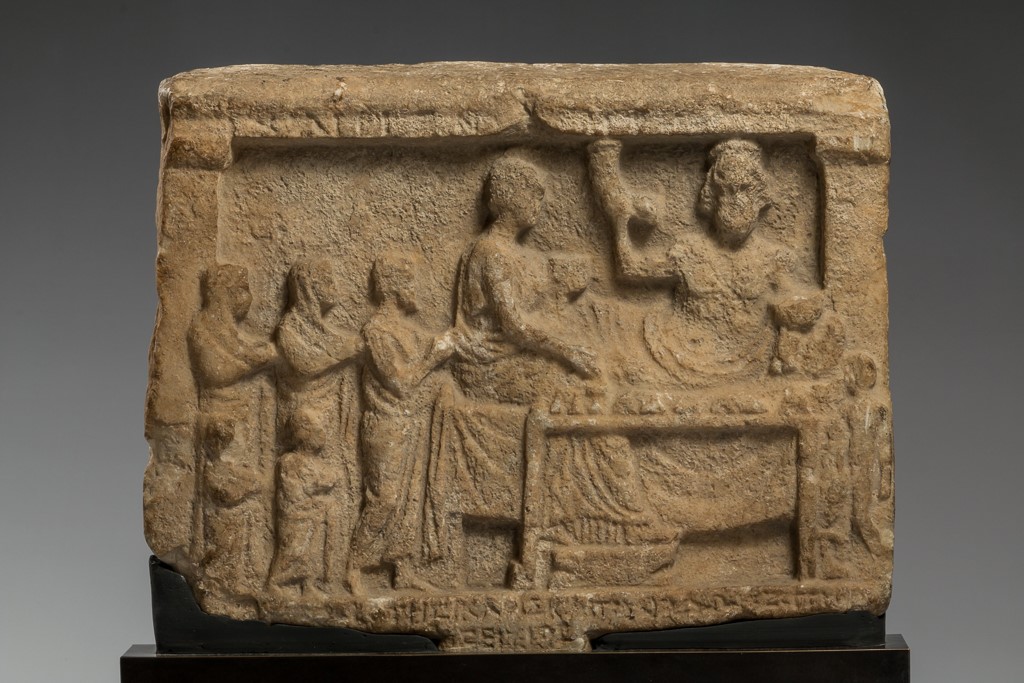
This marble stele would have been set up by worshippers, probably family members, in a shrine or sanctuary as a token of piety, perhaps fulfilling a vow or a prayer. This example is a representative of the great age of votive reliefs, the 5th and 4th centuries BC. The marble slab itself, edged with pilasters and a cornice, represents a small shrine. The bottom edge has a tang for insertion into a base.
A male figure reclines on a couch, holding an animal-head rhyton (a drinking cup) in one hand and a bowl in the other. He wears a polos (crown) and his himation (cloak) is draped around his hips, leaving his torso bare. Next to him is seated a woman wearing a chiton and holding a pyxis (a small round box) from which she takes incense to place on the thymiaterion, a type of incense burner, which stands on a low table before them. Before him is a small portable table on which stand a vessel and some food. To the right is a small figure alongside a volute krater, a large vessel in which wine and water were mixed. He is small, not because he is young, but because he is a slave – the slave who serves the wine. There are five figures to the left, at the foot of the couch.
Title: Greek Marble Stele of the Type Known as a Hero Relief - 2013.03
Acquisition number: 2013.03
Culture or period: Greek Classical.
Date: Mid 4th century BC.
Material: Stone - Marble
Object type: Funerary items - Grave stelae
Dimensions: 358mm (w) × 175mm (h)
Origin region or location: Türkiye
Display case or on loan: 6
Keywords: Greek, Classical, Funerary, Charites, Ktesikles, Pythodoros
N. Kaltsas, Sculpture in the National Archaeological Museum, Athens, Los Angeles, J. Paul Getty Museum, c.2002, no.482. See also G. Ekroth, ‘The Cult of Heroes’, in S. Albersmeier (ed.), Heroes: Mortals and Myths in Ancient Greece (Baltimore 2009) 120-143.A. Shapiro, ‘Looking at Vases and Sculpture Together: The Banqueting Hero’, in S. Schmidt and J.H. Oakley (eds), Hermeneutik der Bilder: Beiträge zu Ikonographie und Interpretation Griechischer Vasenmalerei. Beihefte zumCVA Deutschland IV (Munich 2009) 177-186.
E. Minchin, “Greek Marble Stele with Votive Hero Relief’, in R. Ridley, B. Marshall and K. Morrell (eds.) Fifty Treasures: Classical Antiquities in Australian and New Zealand Universities, The Australasian Society for Classical Studies (Melbourne, 2016), 12-13.
2013.03
Greek Marble Stele of the Type Known as a Hero Relief.
Height 17.5cm (excl. tang); width 35.8cm
Presented by the Friends of the ANU Classics Museum, in memory of Jill Downer.
Mid 4th century BC. The surface is somewhat worn.
This marble stele would have been set up by worshippers, probably family members, in a shrine or sanctuary as a token of piety, perhaps fulfilling a vow or a prayer. This example is a representative of the great age of votive reliefs, the 5th and 4th centuries BC. The marble slab itself, edged with pilasters and a cornice, represents a small shrine. The bottom edge has a tang for insertion into a base.
A male figure reclines on a couch, holding an animal-head rhyton (a drinking cup) in one hand and a bowl in the other. He wears a polos (crown) and his himation (cloak) is draped around his hips, leaving his torso bare. Next to him is seated a woman wearing a chiton and holding a pyxis (a small round box) from which she takes incense to place on the thymiaterion, a type of incense burner, which stands on a low table before them. Before him is a small portable table on which stand a vessel and some food. To the right is a small figure alongside a volute krater, a large vessel in which wine and water were mixed. He is small, not because he is young, but because he is a slave – the slave who serves the wine. There are five figures to the left, at the foot of the couch.
The remarkably detailed inscription in Greek (above and below the relief) identifies this as a funerary banquet. The reclining figure, Charites, is identified as a ‘hero’. This term alludes to the hero-cults that sprang up in the 8th century in Greece, when the heroes of the Trojan War began to be worshipped as powerful figures even in death, as an intermediate class between men and gods. By the 5th century BC the word ‘hero’ was extended as a term of honour to include ordinary mortals who had lived exceptional lives and who, after death, might by worshipped.
What is celebrated at this banquet is the moment of Charites’ heroisation, in the presence of his wife and, according to the inscription, his ‘natural-born sons’, Ktesikles and Pythodoros, and three others, all five bearing offerings. The scene is tranquil. It is not a scene of mourning (as on a grave monument), but a scene marked by solemnity, as the family of Charites, now his worshippers, remember him and honour him.
For a comparandum, see N. Kaltsas, Sculpture in the National Archaeological Museum, Athens, Los Angeles, J. Paul Getty Museum, c.2002, no.482. See also G. Ekroth, ‘The Cult of Heroes’, in S. Albersmeier (ed.), Heroes: Mortals and Myths in Ancient Greece (Baltimore 2009) 120-143.A. Shapiro, ‘Looking at Vases and Sculpture Together: The Banqueting Hero’, in S. Schmidt and J.H. Oakley (eds), Hermeneutik der Bilder: Beiträge zu Ikonographie und Interpretation Griechischer Vasenmalerei. Beihefte zumCVA Deutschland IV (Munich 2009) 177-186.
E. Minchin, “Greek Marble Stele with Votive Hero Relief’, in R. Ridley, B. Marshall and K. Morrell (eds.) Fifty Treasures: Classical Antiquities in Australian and New Zealand Universities, The Australasian Society for Classical Studies (Melbourne, 2016), 12-13.