Acquisition number: 2012.04
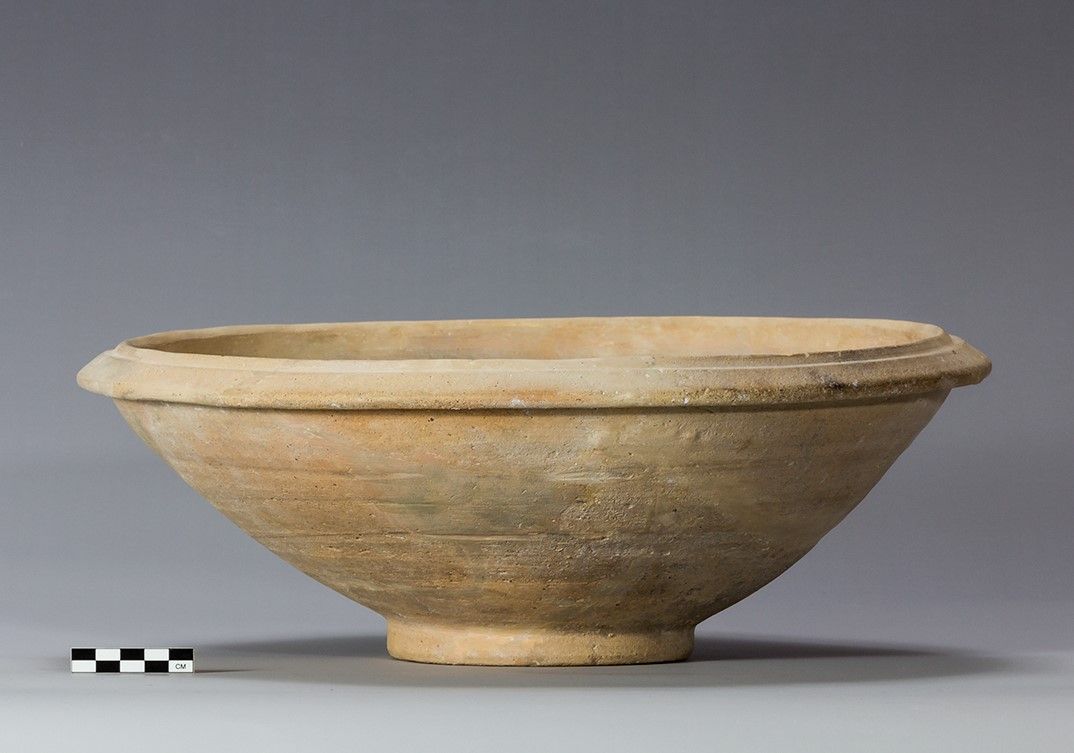
Other images
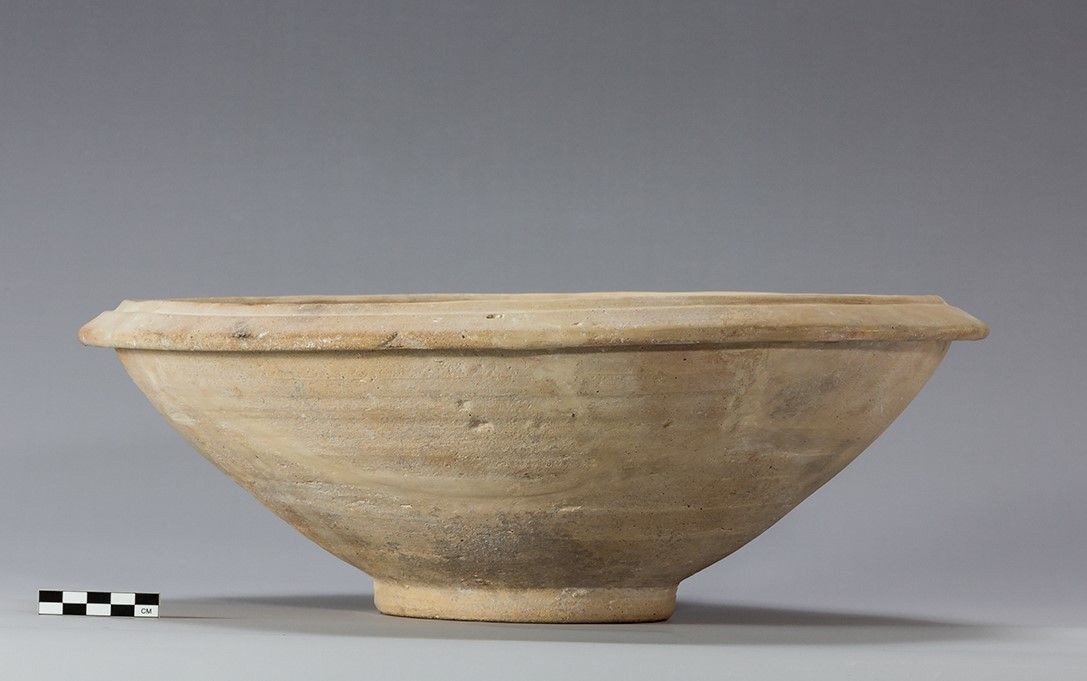
A deep bowl with stepped rim projecting on the exterior at an angle. It has been classified as Type 16.2, which is a slightly coarser version of a painted bowl used for mixing wine and water. It is well-levigated; its interior wall is thickened above the ring base, but not in the centre floor. There is no handle. The rim profile occurs frequently in the Levant, belonging to bowls that may be either kitchenware or tableware.
Title: Large Commonware Deep Bowl or Mortarium - 2012.04
Acquisition number: 2012.04
Culture or period: Hellenistic.
Date: 3rd - 2nd century BC.
Material: Clay - Terracotta
Object type: Mortarium
Origin region or location: Syria
Origin city: Jebel Khalid.
Display case or on loan: 4
Keywords: Jebel Khalid, mortarium, krater
H. Jackson and J. Tidmarsh, Jebel Khalid on the Euphrates, vol. 3: The Pottery (Sydney, Meditarch, 2011), 40-44, 150-151 (fig. 33) and Plate 5.
2012.04
Large Commonware Deep Bowl or Mortarium
On loan from Professor Graeme Clarke AO FAHA, co-director of excavations at Jebel Khalid, Syria. Diam. 31.5cm; ht. 13.5cm; base diam. 12.0cm.
JK; inventory number 89.939; pottery catalogue number JK CW 235
A deep bowl with stepped rim projecting on the exterior at an angle. It has been classified as Type 16.2, which is a slightly coarser version of a painted bowl used for mixing wine and water. It is well-levigated; its interior wall is thickened above the ring base, but not in the centre floor. There is no handle. The rim profile occurs frequently in the Levant, belonging to bowls that may be either kitchenware or tableware.
From Area S (excavated 1988-1995) at Jebel Khalid.
The site of Jebel Khalid was rich in large, deep bowls. Bowls such as this one were used both in the domestic context for food preparation and in the symposion, the symposium, as a krater, for the mixing of wine and water.
In this case, the function is uncertain. A mortarium, by definition, is a vessel or grinding or breaking down foods with a pestle. (Coarser pounding would have been done in stone mortars such as the basalt grinders that occur at Jebel Khalid.) A mortarium should have a thick wall, provision to allow for the draining off of liquid, and a sturdy rim for a good grip. Such a bowl for grinding should be classed as a kitchen vessel. But in Near-Eastern pottery studies, mortarium has become a more general term for a large bowl of uncertain function: it may be kitchenware or it may serve as tableware. The lack of wear internally in this bowl suggests it was not used for grinding, so was probably a deep bowl used for mixing and/or serving.
H. Jackson and J. Tidmarsh, Jebel Khalid on the Euphrates, vol. 3: The Pottery (Sydney, Meditarch, 2011), 40-44, 150-151 (fig. 33) and Plate 5.