Acquisition number: 1996.01

Other images
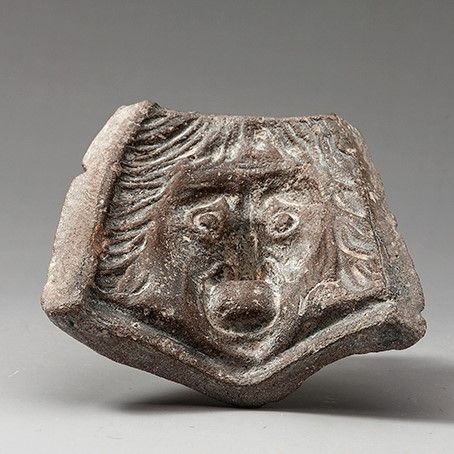
Intact but for the top which has been broken away along the line of a horizontal band in the hair of the mask. Very hard-fired, rather sandy clay with white inclusions, grey on the surface, browner in the breaks. On the moulding face are remains of a darker slip.
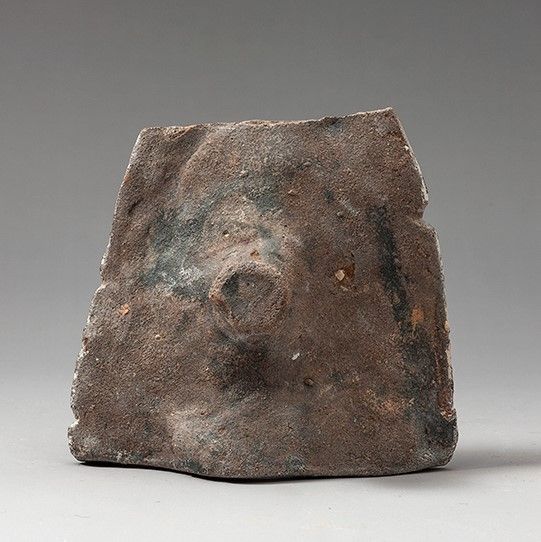
The mould, which is for making models of a tragic actor’s mask, is curved so as to include the full face of the mask. The mask is beardless, with widely open mouth, peaked wavy hair, strongly raised brows, outlined eyes, and furrowed cheeks and brows. The back has a flattened protruding knob for use as a handle.
Title: Mould for a Model Tragic Mask. - 1996.01
Acquisition number: 1996.01
Culture or period: Romano-Egyptian.
Date: 1st century AD.
Material: Clay - Terracotta
Object type: Sculpture and figurines
Dimensions: 116mm (w) × 106mm (h)
Origin region or location: Egypt
Origin city: Alexandria
Display case or on loan: 12
Keywords: Roman, Romano Egyptian, Mould, Orestes, Hippolytos, Roman Egypt, Alexandria, Moustaki Collection
Charles Ede Ltd (London), Greek and Roman Terracotta Sculpture XIV (1996) no. 37 (colour ill.); J.R. Green et al., Ancient Voices – Modern Echoes: Theatre in the Greek World (Nicholson Museum, University of Sydney, 2003) 67 no. 31 (colour ill.).
1996.01
Mould for a Model Tragic Mask.
Purchased; formerly in the Moustaki collection and probably from Egypt (from the region of Alexandria). Max. pres. ht 10.6cm; max. width 11.6cm.
Intact but for the top which has been broken away along the line of a horizontal band in the hair of the mask. Very hard-fired, rather sandy clay with white inclusions, grey on the surface, browner in the breaks. On the moulding face are remains of a darker slip.
The mould, which is for making models of a tragic actor’s mask, is curved so as to include the full face of the mask. The mask is beardless, with widely open mouth, peaked wavy hair, strongly raised brows, outlined eyes, and furrowed cheeks and brows. The back has a flattened protruding knob for use as a handle.
Of Egyptian manufacture and probably of the first century AD. The type represented is that of a youthful male hero, the sort of role like Hippolytos or Orestes.
For an example of a mould for a tragic mask of the late fourth century BC, compare Paris, Louvre D 14, S. Mollard-Besques, Musée National du Louvre:Catalogue raisonné des figurines iii (Paris 1954-) pl. 3b. Small replicas of masks were popular from the fourth century BC onwards and particularly in the Hellenistic period, but not very many moulds are preserved. Like the figurines, such as 1975.19 and 1979.01 in this catalogue, the replicas must have served as souvenirs of favourite characters or to accompany the dead in graves as signifiers of their interests in the theatre, whether for reasons of the Dionysiac and therefore a happy afterlife, or in later periods, as we see on later Roman sarcophagi, of their interest in traditional, classical theatre and therefore of their education.
By this period, the performance of classical tragedy had become strongly conventionalised, with heavy, stiff costume, boots with platform soles, and masks with exaggerated features and gaping mouths. The mask here would also have had a high onkos or crest of hair at the top. Stage movement was limited and formalised. For a slightly later period, see Lucian, On Dance (27), which has been argued to have been written in Antioch about 162-165 AD:
We can form an opinion on the nature of Tragedy in the first instance from its appearance. It is such an ugly and at the same time frightening a spectacle to have a man fitted out to a disproportionate height, mounted up on high footwear, wearing a mask that extends up above his head with a huge gaping mouth, as if he were about to consume the spectators. I don’t elaborate on the padding on his chest and belly with which he creates for himself additional and artificial breadth so that his ungainly height isn’t made obvious by thinness. Then, inside all that, there is the actor himself, wailing, swaying backwards and forwards, sometimes even delivering his iambics in a sing-song voice, and, what is worst of all, making a song of his calamities, presenting himself as responsible just for his voice: everything else was looked after by the poets who lived long ago. One can put up with his singing so long as he is an Andromache or a Hecuba, but when Herakles himself comes on singing, without regard for his rôle and without respect for either his lionskin or his club, a reasonable man would rightly call the matter a solecism.
See also Lucian, Dream or the Cock (26), where the humble cobbler, in observing the problems endured by kings and how his own troubles are minor compared with theirs, uses the analogy of tragic actors:
And so, when they fall, they are just like tragic actors. You can see many of them who for a while are a Kekrops, a Sisyphos or a Telephos, with diadems and ivory-handled swords, wavy hair and gold-decorated cloaks, but - and this is the kind of thing that often occurs - one of them loses his footing and falls down in the middle of the stage. The audience, of course, breaks into laughter when the mask with its diadem is smashed, the actor’s head is bleeding and most of his legs exposed, so that they can see how his undergarments are miserable rags and the (platform-) soles of his shoes are ugly and do not fit his feet.
Charles Ede Ltd (London), Greek and Roman Terracotta Sculpture XIV (1996) no. 37 (colour ill.); J.R. Green et al., Ancient Voices – Modern Echoes: Theatre in the Greek World (Nicholson Museum, University of Sydney, 2003) 67 no. 31 (colour ill.).