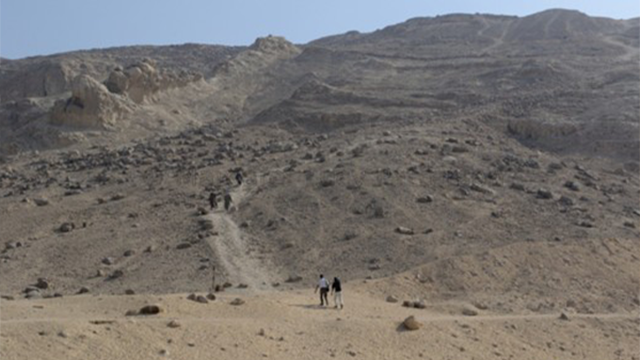
Image: Margaret Lucy Patterson, Hill Path at Deir el-Bersha, Tales from the Two Lands (2016).
Ancient Egypt has left one of the richest archaeological records of the ancient world, yet the lives of most Egyptians remain surprisingly difficult to reconstruct. While thousands of non-royal skeletons have been excavated over the past century, the data is dispersed across excavation reports, museum catalogues, and osteological studies that were possibly never intended for demographic analysis. This seminar explores the methodological challenges of transforming that fragmented evidence into an individual-level paleodemographic database capable of investigating long-term patterns of mortality, survival, and resilience. Drawing on her doctoral research, Michelle will discuss the practical decisions involved in data collection, standardisation, provenance, and bias, and consider how demographic approaches can help bridge archaeology and history.
Rather than presenting final results, the seminar focuses on the process of developing a framework that will allow long-standing questions about ordinary Egyptians, and how they experienced environmental and political change to be investigated using demographic methods.
Speaker:
Michelle Golding is a PhD candidate in Demography at the Australian National University. Her research brings together demography, bioarchaeology, and Egyptology to better understand the lives of ordinary people in the ancient world. Her doctoral research focuses on the development of a paleodemographic framework for reconstructing mortality, survival, and resilience among non-royal populations of Pharaonic Egypt. Before commencing her PhD, Michelle completed a Master of Egyptology at Macquarie University and a Master of Public Policy at the Australian National University. Her research interests include paleodemography, mortality reconstruction, environmental stress, human resilience, and the application of demographic methods to archaeological populations.
Location
Speakers
- Michelle Golding (Australian National University)
Contact
- Marko Vitas