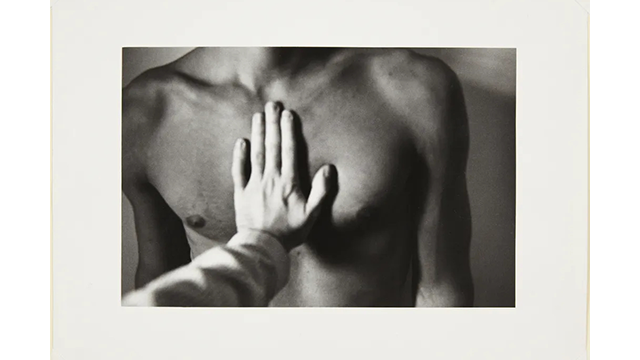
Hervé Guibert, L'Ami, 1980. Gelatin on silver print. Collection of the Princeton University Art Museum. Image © Estate of Hervé Guibert. Courtesy of the Princeton University Art Museum.
North American gay short fiction from the 1980s to 1990s offers insight into the underexamined ways that shame is relieved and communicated relationally, within sexual practices, heterosocial friendships, and queer friend groups and literary networks. Authors such as David Leavitt, Stephen Greco, Allen Barnett, and Richard Hall comprise a network of gay storytellers during the AIDS epidemic, many of whom died during the 1990s, publishing short fiction that remains underexamined in queer and literary scholarship. My work addresses this gap, closely reading the representation of HIV/AIDS in gay short fiction, and drawing from affect theory, friendship studies, psychoanalytic theory, and paratextual evidence of the communities in which the aforementioned writers participated. Incorporating this research into my close reading will reveal North American gay short fiction of the 1980s and 1990s as an underrecognized and vibrant literary episode contributing knowledge pertinent to theories of shame and shame literature. This presentation will illuminate how gay authors complicate notions of responsibility and repulsion, insisting upon the interrelation between shame, eroticism, abjection, and vengeance. My research also contributes a greater understanding of heterosocial friendships in AIDS literature, where the mutual affection between straight women and homosexual men allow gay authors to relieve their shame through self-compassion. Furthermore, I will describe the context from which this literature sprung, addressing the communities gay authors cultivated, and the mechanisms of shaming within gay men’s friend groups, where shame becomes an imbricating, creative channel intertwined with romantic intimacy and collective identity. This subgenre and literary network exposes the relational operations through which shame continually flares and eases: a lingering force that, through writing and relationships, becomes an occasion for pleasure, solicitude, and inventiveness.
This presentation will also describe my short story collection, Schoolboys, which follows several young queer men in present-day Australia. Although it portrays a vastly different context, 1980s and 1990s gay short fiction profoundly inspired Schoolboys’ formal qualities and interests, namely its investment in relationships that dramatise the intersection of shame, desire, and transformation. Replicating a narrative throughline in gay male AIDS literature, Schoolboys continually places faith in the utility of friendship, particularly heterosocial friendship, where the pursuit of safety and belonging momentarily displaces the desire for sexual gratification. I will demonstrate that understanding the mechanisms of shame in literature, and particularly AIDS literature, might allow contemporary authors to apply them deliberately and evoke shame with deeper affective realism, thus contributing new insights regarding the possibilities of shame as material for fiction writing and the formal apparatuses therein.
Edmario Lesi is a PhD candidate of English and Creative Writing at The Australian National University. He is supervised by Dr Lucy Neave (primary), Dr Katie Sutton, Dr Chloe Green, Dr Shameem Black, and Dr Rosanne Kennedy. His short fiction has appeared or is forthcoming in Swamp Pink, Island, Antipodes, Carte Blanche, The Suburban Review, Complete Sentence, and elsewhere. The writing of his short story collection, Schoolboys, was supported by the 2025 Queensland Writers Centre Fellowship for Underrepresented Writers.
Location
Speakers
- Edmario Lesi (ANU)
Event Series
Contact
- Monique Rooney
Image Gallery